

This site is no longer active!
If you are the owner, you must reactive this site for it to be published again
or contact us at support@rebolthq.com

If you are the owner, you must reactive this site for it to be published again
Chimney cap blown off? Learn how to protect your home today, when repair is enough, and when you really need a custom chimney cap.
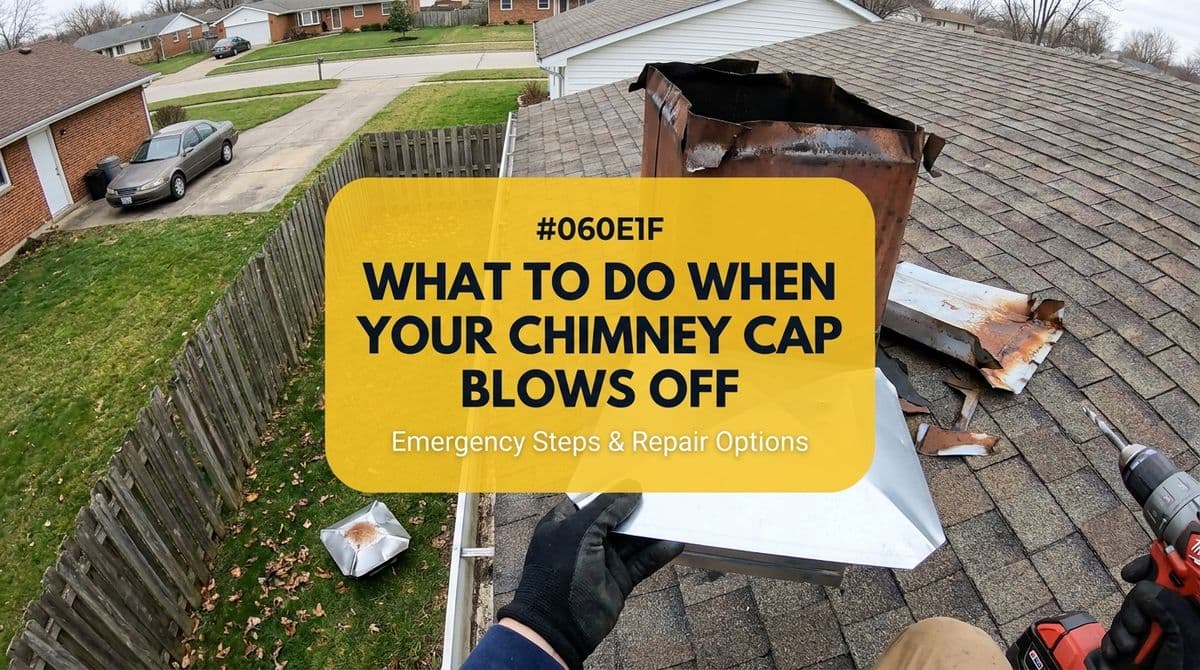
We recently got a call from a homeowner — let's call him Harold — whose chimney cap blew clean off during a windy night near the lake. He told us the cap actually survived the fall and looked “surprisingly in pretty decent shape,” but at 75, there was no way he was climbing a ladder to check things out himself.
Harold’s biggest worries were simple and very common:
We handle calls like Harold’s every storm season, so I want to walk you through exactly what to do when your chimney cap blows off, how we approach emergency protection, and how we decide between reusing, replacing, or ordering a custom-made chimney cap.
The moment you realize your chimney cap is gone, your instinct might be to grab a ladder. Please don’t. Harold mentioned he’d need “a pretty good-sized ladder” to reach his, and that’s true for most homes. Between height, wind, and steep roof pitches, this is a job that’s safer for a roofing pro.
Here’s what you should do right away:
Once we’re on-site, we start with a roof and chimney inspection from the outside. In Harold’s case, he suspected the cap had been stuck down with “concrete glue or something” to the flashing and had finally let go after decades of exposure.
On a typical visit, here’s what we look at:
From there, we can give you our honest recommendation: reuse and re-secure the old cap, install a new standard-size cap, or measure for a custom chimney cap.
Like we explained to Harold over the phone, our first goal is to save you money without cutting corners. If your old cap is structurally sound, we often can:
This is usually the fastest and most cost-effective option, and if the cap fits well and meets current safety standards, there’s no reason not to reuse it.
Sometimes, though, the cap that blew off is already a one-of-a-kind. Harold suspected his was “a custom deal,” and he was probably right — many older chimneys and certain pellet or wood-burning systems use non-standard sizes or designs.
We typically recommend a custom chimney cap when:
As we told Harold, custom caps aren’t something you just grab off the shelf at the big box store. We measure your chimney, consult with our metal fabricator, and then provide an estimate based on the design, material, and finish.
Harold asked if he could get an estimate right away, and that’s usually possible. Here’s how we handle it:
In the meantime, if rain is on the way, we always prioritize a secure temporary cover the same day to protect your home until the permanent solution is ready.
Once everything is secure again, a few simple habits can help you avoid another surprise like Harold’s:
If your chimney cap has blown off — whether it’s sitting intact in your yard like Harold’s or nowhere to be found — don’t wait for the next storm. Call a qualified roofing or chimney professional to get it inspected, covered, and safely secured again.