

This site is no longer active!
If you are the owner, you must reactive this site for it to be published again
or contact us at support@rebolthq.com

If you are the owner, you must reactive this site for it to be published again
Rodents in your attic often start with tiny roof problems. Learn how roof damage lets mice in and how a roofer inspects and repairs those entry points for good.
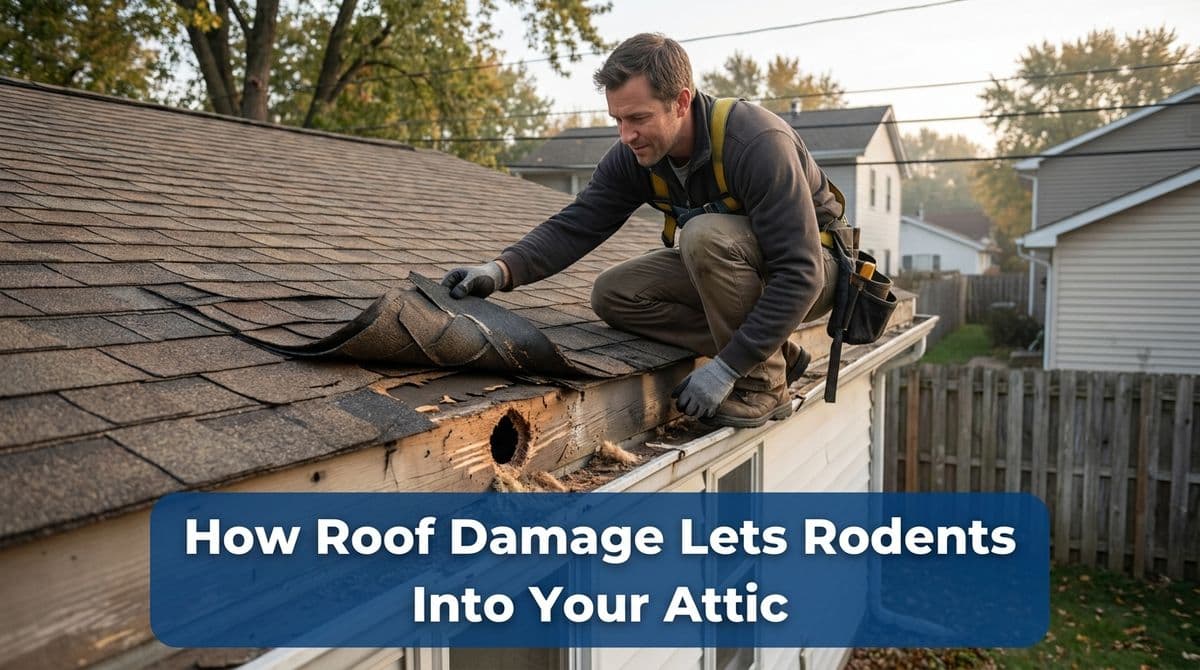
We recently got a call from a customer — let's call her Brittany — in the Slate area who was at her wits’ end with mice in the attic. She’d already had an exterminator out twice. On the second visit, he lay down in the yard, looked up at just the right angle, and spotted something Brittany never would’ve noticed from the ground: a shingle near the roof edge had curled up, leaving a gap big enough for mice to squeeze through.
That tiny opening was all it took to turn her roof into a rodent entry door.
When Brittany called us, she said, “The exterminator thinks they’re getting in through the roof where a shingle curled up. Can you come out and check it and give us a quote to repair it?” We told her what we tell a lot of homeowners in this situation: if rodents have found one weak spot, there may be others. The key is a thorough roof inspection focused specifically on animal entry points — not just leaks.
Most homeowners think of roof damage in terms of water leaks and stains on the ceiling. Rodents look at the same issues and see something very different: easy access to warmth, nesting material, and food smells from the house below.
Here are a few ways roof problems can turn into rodent highways:
Because mice can squeeze through holes as small as a dime, what looks like a “hairline gap” to you might be a wide-open doorway to them.
When we scheduled Brittany’s inspection, we explained that we’d do more than just go up, glance around, and slap a shingle back down. A proper critter-intrusion inspection follows a methodical process to make sure we’re not missing hidden access points.
Before we ever set up a ladder, we walk the property and look at the roof from multiple angles — just like Brittany’s exterminator did when he lay down and looked up. From the ground, we can often spot:
Next, we carefully walk the roof, paying extra attention to the areas rodents love most:
We’re not just looking for “big problems.” For rodent control, the tiny details matter — a half-inch gap under a shingle can be more important than a large cosmetic defect.
If the homeowner is comfortable with it and access allows, we’ll also take a quick look inside the attic. From inside, we can often see:
This “inside-out” view helps confirm what we’re seeing on the roof and ensures we’ve found all the paths the rodents might be using.
Once we’ve identified the problem areas, we put together a repair plan. For a situation like Brittany’s, that often includes a mix of shingle repair and sealing work.
Depending on what we find, we may:
The goal is not only to stop rodents but also to prevent future water damage, since the same weak spots that let in critters can eventually cause leaks.
Beyond shingles, we also address secondary entry points:
We always recommend coordinating with your pest control company so they can confirm that all access points are sealed and set traps or treatments as needed inside.
You don’t have to climb on the roof to catch problems early. A few habits can go a long way:
If you see anything that looks suspicious or you’ve already had an exterminator point to a possible roof entry, that’s a good time to call a roofer for a focused critter-intrusion inspection.
Brittany did the right thing by calling us after her exterminator suspected a roof issue. Pest control can remove the mice, but only solid roof repairs will keep them from coming right back.
If you’re dealing with scratching in the attic, droppings, or a pest pro has mentioned a possible roof entry point, we’re happy to come out, walk the roof, and give you a clear, detailed estimate on repairs. Stopping rodents often starts on the rooftop — and a careful inspection is the first step.