

This site is no longer active!
If you are the owner, you must reactive this site for it to be published again
or contact us at support@rebolthq.com

If you are the owner, you must reactive this site for it to be published again
Have a flat TPO roof that’s leaking but not failing? Learn when a silicone coating can be smarter than a full replacement, including costs, pros, cons, and warranty details.
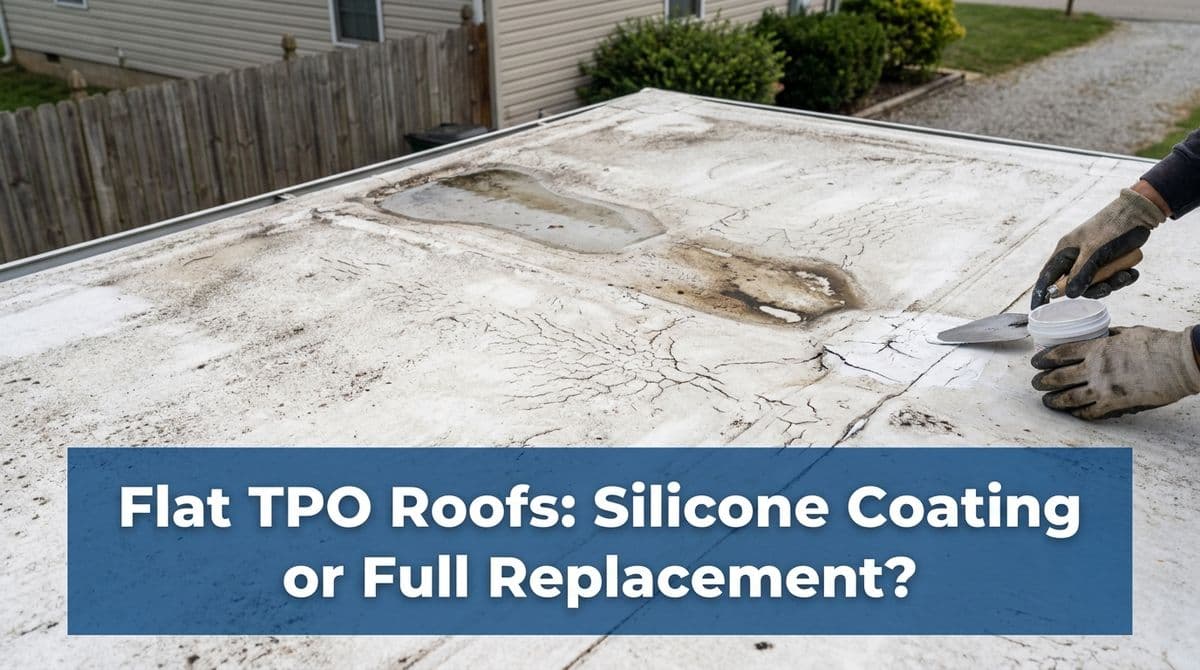
We recently got a call from a property manager — let’s call him Mark — who takes care of several commercial buildings in the downtown Waco area. He told us he wasn’t dealing with a big insurance claim or hail damage. Instead, he had a newer flat TPO roof that had some construction damage, a few questionable repairs, and even some birds that had taken up residence.
Mark had already gotten a quote from another company and was very clear about what he wanted: something competitive, reliable, and backed by a real warranty — but not a full tear-off and replacement. He’d been searching for a “paintable TPO” product and wanted to know if a silicone coating system would actually work and be worth the money.
That conversation is one we have often, so I’ll walk you through how we answered Mark — and how we help owners decide when a silicone roof coating over TPO makes more sense than a full replacement.
Because Mark’s roof was relatively new and structurally sound, we recommended a silicone coating system instead of ripping everything off and starting over. The system we’re certified to install is the Uniflex roofing system by Sherwin-Williams.
Here’s the basic idea: instead of cutting out and replacing sections of TPO, we restore and encapsulate the existing membrane. That gives him a watertight surface and a new 15-year warranty without the mess and cost of a replacement.
We start with a thorough inspection of the TPO:
In Mark’s case, he had some construction damage that was “sealed, but maybe not properly” and bird activity that left the surface dirty. So we planned for a thorough cleaning and localized repairs before any coating went down.
Once the roof is cleaned and dry, we apply a base coat and flashing system called Uniflex One Flash. Think of it as a rubberized seal that we use to reinforce all the weak points:
This step is where we stop potential water intrusion before it starts. Instead of adding new cuts and patches, we’re building a continuous, flexible layer over the trouble spots.
After the One Flash work is complete and cured, we apply a silicone top coat over the entire roof. This is what gives you the full encapsulation and long-term waterproofing.
Silicone is highly reflective and UV-resistant, which helps keep rooftop temperatures down and slows aging of the underlying TPO. When the system is installed to manufacturer specs, it’s eligible for a 15-year material and labor warranty.
For owners like Mark, who are managing multiple properties and just want a “good square deal” without over-spending, this approach checks all the boxes.
We’re coating specialists, but we’re also honest: sometimes a coating is not the right answer. Replacement might be better if:
In those cases, you’re usually better off investing in a full system replacement instead of putting a new coating over deeper problems.
Every roof is different, but owners often ask us for rough ranges to help with budgeting. For a typical flat or low-slope TPO roof:
Those ranges are not quotes, but they illustrate why owners like Mark look for coating options when the existing TPO is still in decent shape.
Mark specifically asked, “What works, what has a warranty, and who’s going to stand behind it?” With a system like Uniflex, the 15-year warranty is available when the coating is applied at the specified thickness and over a roof that meets the manufacturer’s conditions.
Here’s what that typically means for you:
Because we’re local, we tell customers like Mark that we’re happy to be the ones who manage that warranty — checking the roof periodically and making sure the system continues to perform as intended.
Once your TPO is coated, you don’t just forget about it. The roof should be low-maintenance, but not “no-maintenance.” We recommend property owners:
Handled this way, a good silicone system can easily deliver its full service life and sometimes longer.
Like Mark, you may be getting multiple quotes and just want a straight answer. When you’re comparing roofing contractors for a silicone coating over TPO, ask each one:
If you’re hearing mostly about price and very little about process, prep, and warranty details, that’s a red flag. A good installer will explain exactly how they’re going to prepare and protect your roof, just like we did for Mark.
If you’ve got a flat or low-slope TPO roof that’s leaking around seams, patches, or penetrations — but it isn’t ancient or falling apart — a silicone roof coating may be the most cost-effective way to extend its life.
We’re always happy to come out, take a look, and give you an honest opinion. Sometimes that means a coating and a 15-year warranty; sometimes it means telling you it’s time for a full replacement. Either way, you’ll know where you stand and what your real options are.